







About the Center
Through a combination of breakthrough optical imaging and computational genomics, the Center for Physical Genomics and Engineering (CPGE) focuses on studying and manipulating chromatin structure, which regulates gene expression, in order to treat disease and engineer living systems to overcome environmental challenges.
The Center for Physical Genomics and Engineering is part of the McCormick School of Engineering.

Our Strengths
Learn more

Education
Discover mentorship programs, symposia, and opportunities for gaining practical experience available to graduate students and postdoctoral researchers.
Knowledge Transfer
Find out how the center trains the next generation of scientists and engineers through cross-disciplinary platforms.
What is Physical Genomics?
Physical genomics is a new field that involves understanding the structure, function, and fundamental principles of the genome. With this understanding, researchers can reversibly regulate, control, and even reprogram global patterns of gene expression.
The Next Frontier in Biological Discovery
"The impact of this emerging field could be widespread: ranging from treating diseases to improving crop yields and mitigating the impact of climate change on plants."
-- Vadim Backman, Director of Center for Physical Genomics and Engineering
News & Events
News

NSF Awards Northwestern $30 Million to Establish New Center
NSF Awards Northwestern $30 million to Establish the Center for Genome Intelligence Engineering
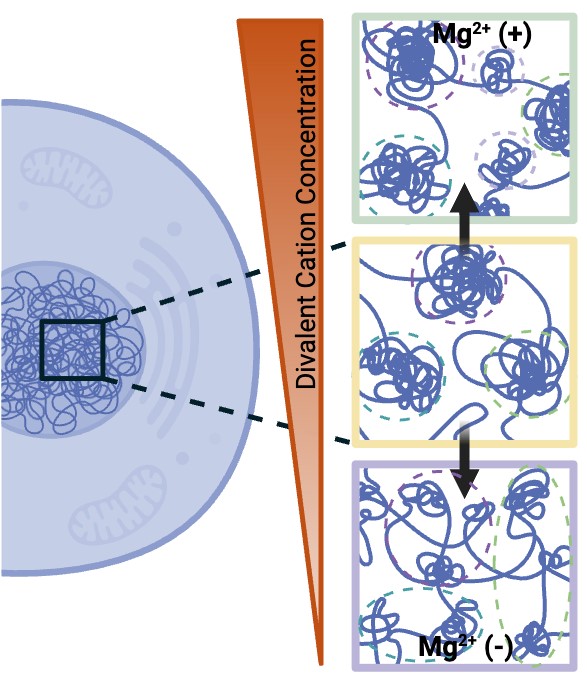
Study Reveals New Way Cells Organize Their Genomes
Changing the nucleus’s chemical environment reshapes chromatin, alters cancer cells’s response to chemotherapy

Agential Topics by Agential Biology Institute
In an invited talk organized by Agential Biology Institute Dr Vadim Backman spoke about the computational properties of the genome, including chromatin and, his specialty in epigenetics and genetics.
New CPGE Research Published in Biophysical Journal
Chromatin domains, boundaries, and contact enrichments are often interpreted as fixed structural entities, even though most experimental measurements are averaged over large and heterogeneous cell populations. A new modeling framework developed at Northwestern’s Center for Physical Genomics and Engineering, SR-EV, and published this month in Biophysical Journal shows that many of these features can be understood as emerging from minimal geometric rules combined with ensemble-level bias, without requiring explicit molecular interactions or deterministic folding mechanisms. By distinguishing single-configuration heterogeneity from ensemble-level statistical organization – including the emergence of chromatin packing domains– SR-EV supports an interpretation in which chromatin organization is realized in individual cells but must be analyzed through ensembles. This perspective clarifies the probabilistic nature of genome architecture and provides a tractable reference framework for interpreting multimodal genomic and imaging data.
Events
Application for degree due to The Graduate School to receive a de...
October 23
All Day
Seeing the Invisible: Real-Time Vascular Imaging with Wearable Op...
October 29
4:00 PM - 5:00 PM
The Monthly Seminar on Physical Genomics: Gene Dosage Control And...
October 30
12:00 PM - 1:00 PM
Regular registration for Winter quarter begins
November 16
All Day